
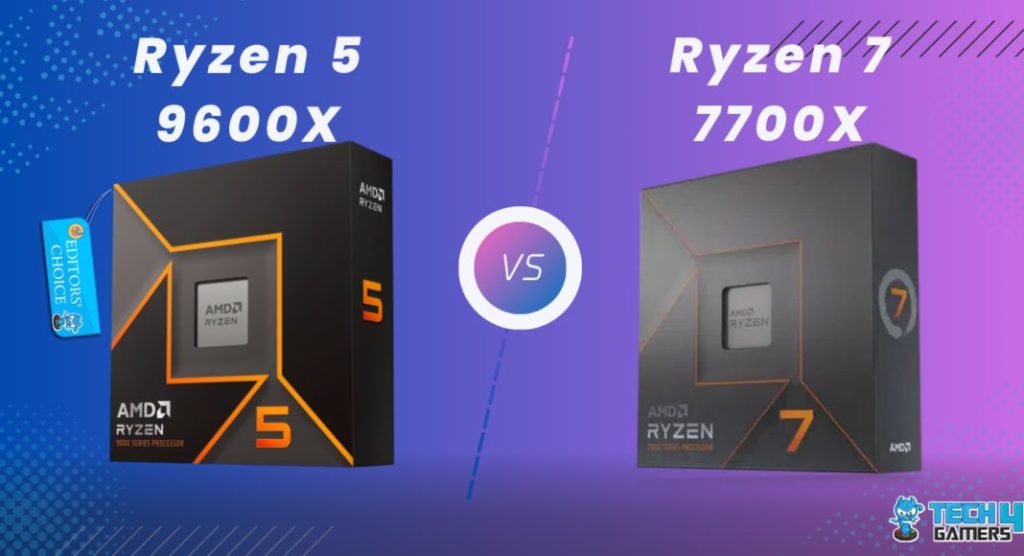
Verdict: the AMD Ryzen 5 9600X delivers more performance per euro and far better performance‑per‑watt, making it the clear value pick for budget‑focused gamers in the Balkans; the Ryzen 7 7700X only justifies its higher price if you absolutely need the extra cores and can absorb the extra power draw.
Why the 9600X beats the 7700X on a tight budget
The 9600X costs $173 USD according to Tom’s Hardware; the 7700X is $233 USD from the same source. In 1080p gaming the 9600X hits 72.6 % of the fastest CPU , while the 7700X manages 70.6 % . That works out to about 0.42 % performance per dollar for the 9600X versus 0.30 % for the 7700X (roughly 38 % more performance per euro‑dollar spent).
Power‑efficiency is even more stark. The 9600X runs at a 65 W TDP (max 88 W) , delivering 72.6 % gaming performance, which is about 1.12 % performance per watt. The 7700X draws 105 W (max 142 W) , giving 70.6 % performance or 0.67 % per watt (roughly 66 % less efficient). In places where electricity costs are high, that gap adds up fast.
Price and availability in the Eurozone
European shoppers see the 9600X listed at a low of €179 , €21.5 cheaper than the 7700X’s €200.49 (so it’s noticeably cheaper). It also shows up in 14 online shop listings , while the 7700X is only in five . More sellers mean better chances of finding a deal, lower shipping costs, and quicker delivery, all important for Balkan buyers dealing with limited stock.
Core count, future‑proofing and real‑world impact
The 9600X is a 6‑core/12‑thread chip built on Zen 5 . The 7700X adds two more cores and four more threads (8/16) on Zen 4 , so it’s got more parallel capacity. In theory, the extra cores help with heavy multithreaded workloads such as video rendering or running many browser tabs.
For most 1080p gaming rigs in the Balkans, however, the bottleneck is usually the GPU, not the CPU. The 2‑core advantage of the 7700X rarely translates into a noticeable FPS bump in titles that cap at 144 Hz or lower. If you plan to use the PC for occasional content creation, the 7700X’s extra cores could be useful, but you’ll pay a premium for them. (The bottleneck is usually the GPU, not the CPU.)
Here’s where to start. For a deeper getting into the 9600X’s overall worth, see our dedicated review. If you’re weighing core count against price, the Ryzen 9 7900X vs Core Ultra 7 comparison shows how much extra cores cost on newer platforms. (Weighing core count against price.)
Side‑by‑side specs
| Attribute | Ryzen 5 9600X | Ryzen 7 7700X |
|---|---|---|
| US street price (USD) | $173 source | $233 source |
| Lowest EU price (EUR) | €179 source | €200.49 source |
| 1080p gaming score % | 72.6 % source | 70.6 % source |
| TDP (W) / Max power (W) | 65 W / 88 W source | 105 W / 142 W source |
| Cores / Threads | 6 / 12 source | 8 / 16 source |
| Shop listings (EU) | 14 source | 5 source |
Putting the numbers into a real‑world budget
Let’s run the numbers. Assume you’re building a 1080p gaming PC for €800 total (including GPU, RAM, SSD, and case). Adding the 9600X at €179 leaves €621 for the rest of the parts, which comfortably covers a solid mid‑range GPU such as a Radeon RX 6600 or an Nvidia RTX 3060‑Ti in the Balkan market. Swapping in the 7700X bumps the CPU cost to €200.49, shaving €18.51 off the GPU budget. That €18.51 could be the difference between a 1080p‑capable card and a 1440p‑ready one. (The €18.51 could be the difference between a 1080p‑capable card and a 1440p‑ready one.)
Here’s the power side. Because the 9600X also draws ~40 W less under load, you’ll see a lower electricity bill. If you run 4 hours of gaming daily, the 9600X saves roughly (105 W‑65 W) × 4 h = 0.16 kWh per day. At €0.15/kWh (typical Balkan rate), that’s €0.024 per day, or about €9 per year – a modest but real saving that adds up over a 5‑year lifespan. (Saving roughly (105 W‑65 W) × 4 h = 0.16 kWh per day.)
If you’re still debating whether to stretch for the extra cores, the GPU Upgrade Calculator can show if that extra CPU money would be better spent on a stronger graphics card (extra cores).
What the data can’t tell you
Our numbers stop at raw gaming scores, TDP, and price. They don’t capture:
- How each CPU performs with specific modern titles that rely heavily on single‑core speed versus multi‑core scaling.
- Potential differences in motherboard compatibility, BIOS updates, or required VRM quality for the higher‑power 7700X.
- Long‑term resale value in the Balkan second‑hand market, where older Zen 5 chips might retain value differently than Zen 4.
- The impact of future driver or game engine optimisations that could favour one architecture over the other.
Until you’ve got a concrete build plan, those factors remain unknown and should be weighed alongside the hard numbers above.